
The board said that practices provided by Muslim Personal Law on the issues of marriage, divorce and maintenance were based on holy scripture Al-Quran and "courts cannot supplant its own interpretations over the text of scriptures".

The Union government's move to make registration of all marriages compulsory may run into rough weather as prominent Muslim organisations and clerics are all set to oppose it tooth and nail.

'Whatever Shami did was right, and there is no need to pay attention to these things. He should focus on the final match and forget all these things.'

"Let them hear us, we are prepared. But we are not ready for out-of-court settlement," Jilani said.

While seeking response from former Union minister and senior advocate Kapil Sibal, representing AIMPLB, the bench said, "Don't infer anything from our side."

In an interview, he recalled how Hashim Ansari, one of the original litigants in the Ram Janmabhoomi-Babri Masjid dispute, took him to the mosque on his bicycle.

Delhi Jama Masjid Shahi Imam Syed Ahmed Bukhari called the killing an "act of cowardice" and "an act against Islam".
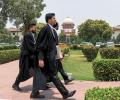
Underscoring the 'presumption of constitutionality in favour of law', the Supreme Court on Tuesday said petitioners challenging the waqf law needed a 'strong and glaring' case for interim relief.
The Muslim Community has reacted with shock at the latest verdict of the Lucknow bench of the Allahabad high court, which ruled that the disputed site is indeed Ram Janmabhoomi and dismissed the suit filed by the Sunni Central Waqf Board as it was barred by limitation.

The decision, they said, has given new hope to Muslim women.
Diminishing the prospects of an out-of-court settlement of the vexed Ram Janmabhoomi-Babri Majid issue, Muslim bodies are gearing up to file five more Special Leave Petitions in the Supreme Court to challenge the Allahabad High Court verdict.
It urged Muslims to express their anguish by observing a peaceful bandh, but prevent vested interests from taking advantage of the situation to create trouble.

Cabinet minister Maurya said that the BJP will help such victims to them get respect.
Samajwadi Party chief Malayam Singh Yadav visited the Islamic seminary Datul Uloom Nadwatul Ulema along with his close aide Amar Singh and met its Rector Maulana Rabe Hasan Nadvi, who also is the chairman of All India Muslim Personal Law Board. The former chief minister is understood to have discussed the alleged targeting of Muslims on terror issue, while the Bahujan Samaj Party organised a Muslim convention to reiterate its association with the community.

The Uttar Pradesh government has given the allotment letter to the Sunni Waqf board for the land in Dhannipur village in Sohawal tehsil in Ayodhya on the Lucknow highway, about 18 km from the district headquarters, state government spokesperson Shrikant Sharma told reporters on Wednesday.
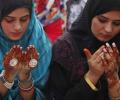
The SC is dealing with legal and constitutional issues relating to discrimination against women in various religions and at religious places including Kerala's Sabarimala Temple.
Hussaini Tigers, an organisation of Shia youths, on Friday urged the All India Muslim Personal Law Board not to approach the Supreme Court against the Allahabad high court verdict on Ayodhya title suits and instead let the matter end here for good.

'The irony of this country is that the party in Opposition and the party in power both depend on Muslims.'
Directing officials to prepare a plan for taking views of Muslim women, the CM asked minister of the department and all women ministers in his cabinet 'to talk to women organisations'.
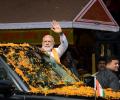
Making an intervention during the discussion on the motion for granting constitutional status to the national commission for backward classes, Modi highlighted that there are sections among Muslims, who are backward, adding that they should be included in the discussion over backward classes.
The verdict in the Ayodhya case has evoked reactions from various quarters. We compile some of them here.

Introducing the bill, Rijiju said the consultation process of the Joint Parliamentary Committee (JPC) was the largest ever exercise carried out by a parliamentary panel in India's democratic history.
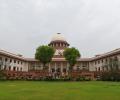
The Indian government has defended the Waqf (Amendment) Act, 2025 in the Supreme Court, arguing that there cannot be a blanket stay on the law as there is a presumption of its constitutionality. The Centre countered the pleas challenging the law's validity, asserting that the amendments were undertaken after a comprehensive study by a parliamentary panel. The government also highlighted the "reported misuse" of earlier provisions and the increase in waqf land, claiming that over 20 lakh hectares were added after 2013.

The Centre on Thursday assured the Supreme Court that it will neither denotify Waqf properties, including "Waqf by user", nor make any appointments to the central Waqf council and boards till May 5.

'If it is proved that a Ram temple was demolished and on the same place a masjid was constructed, I think we have got no right to be there for a moment.'

'When the Bill was passed all have been exposed. There is no difference between communal and secular.'
Former prime minister P V Narasimha Rao is back in the news with the All India Muslim Personal Law Board accusing him of being equally responsible for the demolition of the Babri Masjid in Ayodhya on December 6, 1992. The board went on to say that Rao could never be forgiven for the demolition of the Babri Mosque.

Women candidates married to a man with two surviving wives have also been barred from applying.

'The BJP is keeping its options open and that the final decision is still tightly held.' 'That is consistent with the party's tendency to preserve suspense, avoid premature factional conflict, and use leadership selection as a way of resetting internal hierarchies.'

In an apparent attempt to garner support of Muslims ahead of Lok Sabha polls, Bharatiya Janata Party President and party nominee from Lucknow seat Rajnath Singh met prominent clerics of the community in Lucknow.

AIMPLB member Zafaryab Jilani on Wednesday said the proposed mosque in Ayodhya following last year's Supreme Court verdict is against the Waqf Act and 'illegal' under the Shariat laws.

The Madhya Pradesh high court has dismissed a petition filed by Shah Bano Begum's daughter seeking to stop the release of the Hindi film Haq, inspired by her mother's famous legal battle, holding that a person's right to reputation or privacy is not heritable.

The Madhya Pradesh High Court dismissed a petition seeking a stay on the release of the Hindi film 'Haq', which is inspired by the life and legal struggle of Shah Bano Begum. The court found the petition devoid of merit, clearing the way for the film's release.

In order to formulate a Uniform Civil Code, the Law Commission has sent out of list of 16 questions to gauge public opinion,
The Supreme Court has put on hold several key provisions of the Waqf (Amendment) Act, 2025, including the clause that only those practicing Islam for the last five years can dedicate a property as Waqf. The court also addressed the powers of collectors and non-Muslim participation in Waqf Boards.

Aseem Chhabra ranks the Best of 2025's films that released in theatres, or went directly to OTT platforms.

The Varanasi district court arrived at the decision of allowing 'puja' in a Gyanvapi mosque cellar in "haste", the All India Muslim Personal Law Board (AIMPLB) said on Friday, asserting it would pursue the matter right up to the Supreme Court.

Muslim Personal Law Board has criticised Bharatiya Janata Party leader Subramanian Swamy for his recent statement that mosque is not a religious place and can be demolished any time, saying it was intended to divert people's attention from "failures" of the Centre.
The All India Muslim Personal Law Board on Sunday launched a frontal attack on the Narendra Modi government and announced a nationwide campaign to counter right wing forces.
